 Preview unavailable.
Use the source link to view the original.
400 × 397 px · JPEG · The full frame
Sain (Recordiau) Cyf. · CC BY-SA 3.0
More to discover
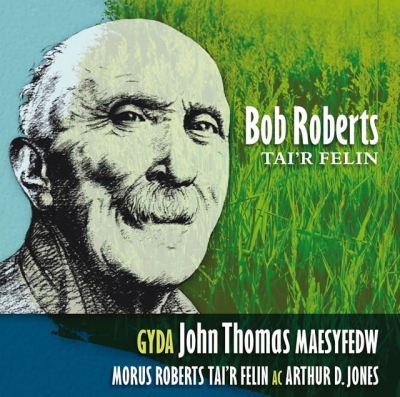 Bob Roberts, Tai'r Felin
Sain (Recordiau) Cyf. · CC BY-SA 3.0
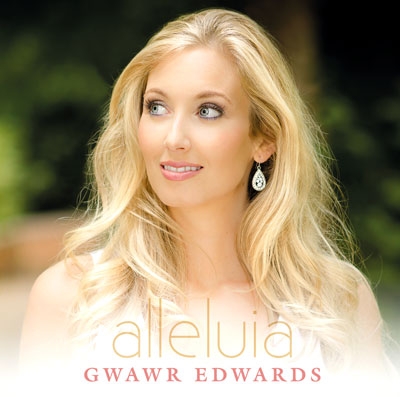 Alleluia
Sain (Recordiau) Cyf. · CC BY-SA 3.0
 Schwanengesang
Sain (Recordiau) Cyf. · CC BY-SA 3.0
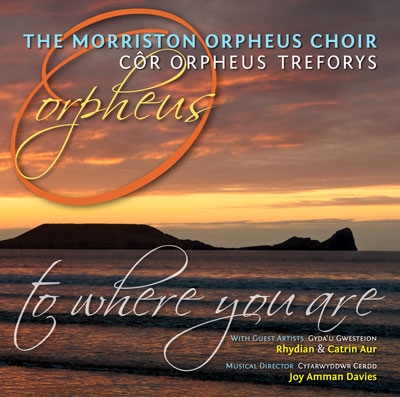 To Where You Are
Sain (Recordiau) Cyf. · CC BY-SA 3.0
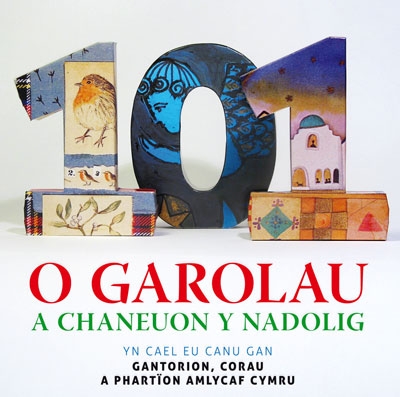
101 O Garolau A Caneuon Nadolig
101 Christmas Songs
Album artwork for 101 Christmas Songs, provided through the SAIN Records collection on Wikimedia Commons.
Inside the image.
A square cover on a pale, almost white background. Across the centre stands a row of large, freestanding cut-out forms that together read as “100”: a narrow, irregular “1” at left, a broad dark “0” in the middle and a second, taller “0” at right. Their edges are uneven and the surfaces are filled with small, colourful illustrated scenes. The middle zero is the largest and most prominent; its open centre shows the plain background through it. The forms rest on a thin greyish ground line, with a faint shadow beneath them.
The left-hand “1” is assembled from angular pieces. Its upper section has a blue-grey ground with scattered dark bird-like marks and a strip of multicoloured pattern along the far-left edge. A small rectangular panel below shows a brown bird perched against a pale yellow field. Near the base, a narrow strip contains tiny birds and other motifs. A long, low rectangular piece in front of the numeral shows a branching plant with leaves on a cream ground, bordered by dark red, blue and striped details.
The central zero is a deep blue-black ring decorated with dense, swirling motifs in turquoise, blue, and muted ochre. A stylised face in profile appears in the upper-left portion of the ring, surrounded by curling lines; other areas contain irregular floral or abstract shapes. Its inner opening is an upright oval, mostly white, with a slight grey edge.
The right-hand zero is made from differently shaped sections. Its upper portion is a tall, sloping panel with a dark blue and purple sky-like field, tiny scattered marks and a warm-coloured form near its lower-left edge. Beneath it, a pale pink architectural-looking panel contains a small arched opening and several tiny window-like shapes. A low rectangular piece sits across the front at the bottom right, divided into orange, ochre, pink and brown blocks, with a small blue-green diamond motif and a red triangular form. The pieces have a handmade, cut-and-layered appearance, with some edges and patterned strips visible behind the main shapes.
The title occupies the lower third. Large red serif capitals read “O GAROLAU” on one line, centred and widely spaced. Directly below, smaller green serif capitals read “A CHANEUON Y NADOLIG”. Two short lines of much smaller black text sit beneath: “YN CAEL EU CANU GAN” and “GANTORION, CORAU”; the final line reads “A PHARTÏON AMLYCAF CYMRU”. The typography is clean and sharply set against the pale background, contrasting with the richly decorated, irregular numerals above.
What the image evokes.
The assembled numerals have the quality of a small display made from found illustrations: each piece seems to open onto a different miniature world, yet the pieces fit together as a single emphatic sign. The bird, plant, curling face, architectural arches and coloured blocks suggest the visual pleasure of opening a decorated book and finding a succession of unrelated but companionable images. Their variation gives the composition a celebratory, handcrafted character.
The central ring draws the eye with its dark, saturated blues and restless curls. The face within it lends the number a quietly watchful presence, while the open centre offers a clean pause amid the surrounding ornament. At either side, the lighter panels feel more like painted fragments or little stage flats, especially the right-hand panel with its arches and its dusky, almost theatrical upper section. The result balances graphic clarity with a touch of visual mystery: the numerals announce themselves at once, but their surfaces invite lingering inspection.
The restrained red and green lettering below gives the image a seasonal note without competing with the collage above. The contrast between the precise, formal title and the irregular illustrated forms feels like a meeting of printed programme and handmade decoration. Overall, the cover has the warmth of a festive window display, but its composed spacing and strong central silhouette keep it from feeling crowded.
Associations are subjective readings, rather than documented influences or statements of the artist’s intention.
Read. Share. Reimagine.
These visual notes are offered under CC BY 4.0. Credit dbcovers, link to the source, keep the licence information and indicate any changes.
Ready-to-use attribution
Other attribution formats are allowed when reasonable for the medium and context. The artwork has its own separate licence.
Lettering & observation notes
- O GAROLAU — Large red title, centred below the collage
- A CHANEUON Y NADOLIG — Green subtitle directly below the red title
- YN CAEL EU CANU GAN — Small black line beneath the subtitle
- GANTORION, CORAU — Small black line below “YN CAEL EU CANU GAN”
- A PHARTÏON AMLYCAF CYMRU — Bottom line of small black text
Artwork sources & licence.
Credit the author and source, link to the licence and indicate any changes. Share adaptations under compatible terms. Read the full licence for details.
- Source year
- 2010
- Source author field
- Sain (Records) Ltd
- Attribution
- Sain (Recordiau) Cyf.
- Collection
- SAIN / Wikimedia Commons
- Catalogue number
- SAIN SCD 2647
- Permission evidence
- Public VRT notice: 2017050910011681
- Source checked
- 20 October 2026

Year as recorded on the source file page; it may not represent the work’s first release. File unchanged; browser preview scaled proportionally.