 Preview unavailable.
Use the source link to view the original.
400 × 397 px · JPEG · The full frame
Sain (Recordiau) Cyf. · CC BY-SA 3.0
More to discover
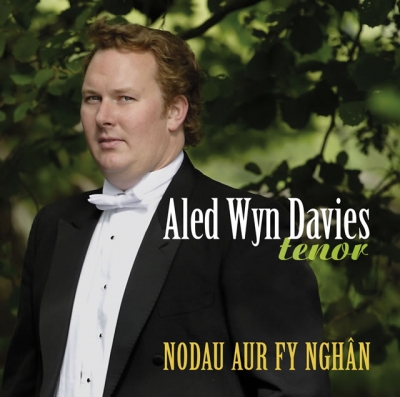 Nodau Aur Fy Nghan
Sain (Recordiau) Cyf. · CC BY-SA 3.0
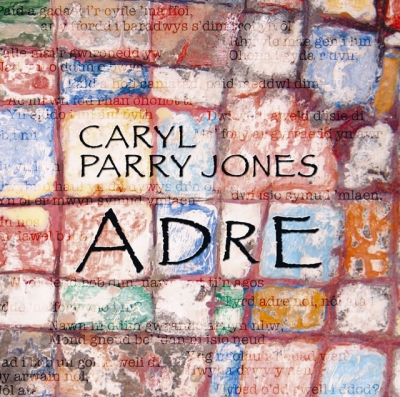 Adre
Sain (Recordiau) Cyf. · CC BY-SA 3.0
 Y Caneuon Cynnar / The Early Songs
Sain (Recordiau) Cyf. · CC BY-SA 3.0
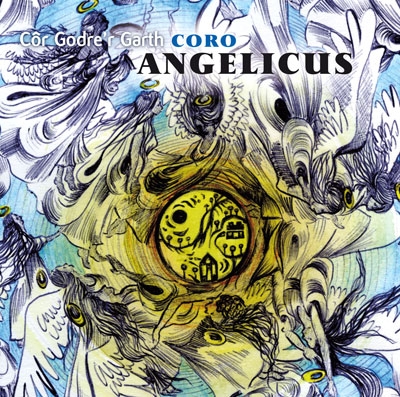 Coro Angelicus
Sain (Recordiau) Cyf. · CC BY-SA 3.0
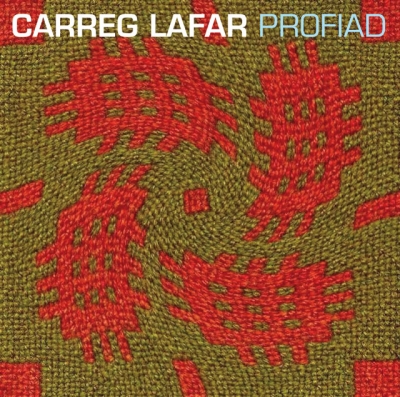
Profiad
Carreg Lafar
Album artwork for Carreg Lafar, provided through the SAIN Records collection on Wikimedia Commons.
Inside the image.
A square cover is filled edge to edge with a coarse woven-looking ground in mottled olive green, ochre and brown. The close-up texture forms a dense grid of tiny raised-looking threads, with no visible frame or margin. Across it are several irregular red forms, distributed around a small red square near the centre. The largest sits in the upper left and extends towards the middle; another tall, branching form occupies the upper right. A broad, roughly horizontal red shape crosses the lower middle, while a smaller vertical form sits at lower left. Partial red marks are cut off at the left and right edges, and another red patch is clipped by the bottom edge, making the pattern feel larger than the square crop.
The red shapes are built from short, blunt strokes and little rectangular or dash-like marks arranged in uneven rows. Some suggest abstracted animals, woven motifs or diagrammatic figures, but none resolves clearly into a definite subject. Their edges are jagged and irregular rather than outlined. Olive and brown flecks remain visible within the red areas, so the figures appear integrated into the same textile-like surface rather than placed over it. The image is flat and frontal, without discernible depth, cast shadows or directional lighting; the close texture and colour variation provide its surface interest.
A single line of large uppercase lettering runs across the top: “CARREG LAFAR PROFIAD”. It is set close to the upper edge and spans nearly the full width. “CARREG LAFAR” appears in pale cream, while “PROFIAD” is light blue-green, with the final letter in red. The narrow sans-serif letters are tightly spaced and sit directly over the patterned ground, partly sharing the space with the red motifs behind them.
What the image evokes.
The cover has the immediate presence of a fragment of woven cloth: its grain is so close and even that the eye almost feels the bumps and crossings of thread. Against that steady ground, the red marks seem to flicker between figures and ornament. They might be creatures viewed in a simplified, emblematic way, or merely a rhythm of stitches and bars; the central square briefly reads like a stray tile or a pause in the pattern.
There is a pleasing tension between the earthy, timeworn palette and the crisp modern lettering at the top. The title announces itself with a clean horizontal line, while the shapes beneath it remain unruly and hand-like. The cropped motifs suggest that this is only one window onto a larger repeating surface. Its effect is both tactile and mysterious: an object-like pattern whose possible meanings stay just out of reach.
Associations are subjective readings, rather than documented influences or statements of the artist’s intention.
Read. Share. Reimagine.
These visual notes are offered under CC BY 4.0. Credit dbcovers, link to the source, keep the licence information and indicate any changes.
Ready-to-use attribution
Other attribution formats are allowed when reasonable for the medium and context. The artwork has its own separate licence.
Lettering & observation notes
- CARREG LAFAR PROFIAD — Across the top edge
Artwork sources & licence.
Credit the author and source, link to the licence and indicate any changes. Share adaptations under compatible terms. Read the full licence for details.
- Source year
- 2002
- Source author field
- Sain (Records) Ltd
- Attribution
- Sain (Recordiau) Cyf.
- Collection
- SAIN / Wikimedia Commons
- Catalogue number
- SAIN SCD 2309
- Permission evidence
- Public VRT notice: 2017050910011681
- Source checked
- 20 October 2026

Year as recorded on the source file page; it may not represent the work’s first release. File unchanged; browser preview scaled proportionally.